

To weigh your guitar accurately, you’ll need a reliable scale that can handle at least 15 pounds while providing precision within 0.1 pounds. First, place your scale on a level surface and zero it out. Remove all accessories from your guitar, then carefully place it on the scale’s center. For bathroom scales, weigh yourself first, then hold the guitar and subtract your weight from the total. Take three measurements to guarantee consistency. Understanding your guitar’s weight helps optimize performance and playing comfort – there’s much more to explore about guitar weights and their impact.
Key Takeaways
- Place a reliable digital or analog scale on a flat, stable surface and ensure it’s properly calibrated to zero.
- Remove all accessories from the guitar, including the strap and any removable components that aren’t part of its core structure.
- For digital scales, center the guitar carefully and wait for the reading to stabilize before recording the weight.
- When using a bathroom scale, weigh yourself first, then hold the guitar and subtract your weight from the combined total.
- Take three separate measurements and calculate the average to ensure accuracy and account for any slight variations.
Why Weighing Your Guitar Matters
When it comes to optimizing your guitar’s performance and playability, understanding its weight is essential for several technical reasons. Your guitar’s weight directly impacts sustain, tonal resonance, and overall balance during performances. Heavier instruments often deliver fuller sounds and enhanced sustain, while lighter ones reduce physical strain during extended playing sessions. Weight considerations are particularly important for electric guitars as they generally weigh between 6 to 10 lbs (2.72-4.55 kg), affecting both comfort and playability. Additionally, the choice of amplifier type can further influence how the weight of your guitar interacts with sound production. Moreover, the cost of beginner level electric guitars typically reflects their weight and material choices, which can affect sound quality. Weight perception also influences your guitar’s performance potential. You’ll need to balance the rich tones typically associated with denser woods against practical concerns like fatigue and mobility.
Choosing the Right Scale Type

Your choice between digital and analog scales will directly impact your guitar-weighing precision, with digital options offering quick, clear readouts while analog scales provide reliable measurements without battery dependence. You’ll need a scale that can handle at least 15-20 pounds to accommodate various guitar types, from lightweight acoustic models to heavier electric variants with hardware. For ideal accuracy in measuring your instrument’s weight, prioritize scales with precision ratings of ±0.1 pounds or better, ensuring consistent and trustworthy measurements for setup adjustments or modifications. Additionally, some guitar amplifiers, like the Monoprice 15-watt tube amp, can also weigh around 25 pounds, demonstrating the importance of having a robust scale for heavier instruments. When choosing a guitar, consider factors like body type and tonewoods, as they can affect overall weight and playability. An example of this is the wood combinations used in bass guitars, which can significantly influence both their sound and weight.
Digital Vs Analog Options
Before selecting a scale to weigh your guitar, you’ll need to decide between digital and analog options, as each type offers distinct advantages for instrument measurement.
Digital scale features include precise gram-level accuracy, quick readings, and convenient unit conversion capabilities. You’ll appreciate the clear display and advanced functions like weight tracking. However, battery dependency can limit reliability during extended use. Many intermediate players may find that having multiple guitars necessitates a more accurate weighing method to assess their collection, as the guitar string gauge can also influence overall instrument weight.
Analog scale benefits center on mechanical durability, consistent performance without power needs, and cost-effectiveness. While they’re less precise than digital models, their spring-based mechanisms provide reliable measurements and require minimal maintenance. Their classic design and straightforward operation make them a dependable choice for basic weight assessment.
When weighing your guitar, consider the weight of electric guitars as it can vary significantly based on materials and design choices.
Weight Capacity Requirements
Selecting the right scale for guitar measurement requires careful consideration of weight capacity specifications.
You’ll need a scale that can handle between 6-12 pounds for the instrument itself, but consider higher capacities if you’re weighing guitars in cases. Digital kitchen scales often max out at 11 pounds, which might limit your options.
Look for scales with proper weight distribution and safety features like non-slip surfaces and auto-hold functions.
For precision, choose a scale that displays weight in small increments. If you’re planning to weigh multiple guitars or transport them, opt for industrial-grade scales that can support up to 50 pounds. Additionally, sound quality is crucial when assessing the overall value of your guitar setup.
Accuracy Level Priorities
When measuring guitars with precision, digital scales emerge as the perfect choice due to their superior accuracy and reliability compared to mechanical or analog alternatives. You’ll want to prioritize scales offering accuracy levels within 0.1 ounces for ideal measurement techniques.
| Scale Type | Accuracy Level | Best Use Case |
|---|---|---|
| Digital | ±0.1 oz | Professional weighing |
| Mechanical | ±0.5 oz | Basic estimates |
| Analog | ±1.0 oz | Rough measurements |
To achieve maximum precision, verify your digital scale is properly calibrated using a known weight reference. Select a model with a clear display and stable base to eliminate measurement variables that could compromise your results.
Step-by-Step Weighing Process
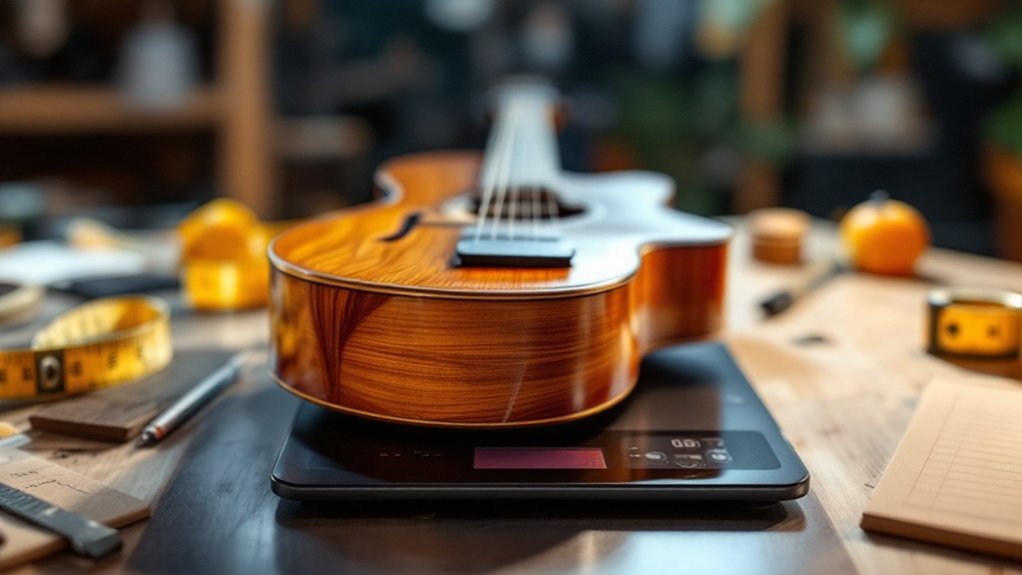
The step-by-step process of weighing a guitar requires meticulous attention to detail and proper preparation.
Start by selecting a digital scale with precise measurement standards, ensuring it’s placed on a stable surface. Remove all accessories and zero the scale before proceeding with your chosen weighing techniques.
For direct measurement, place your guitar carefully on the scale, awaiting a stable reading.
If using the body weight method, weigh yourself first, then with the guitar, and subtract the difference.
Always perform three measurements to establish consistency and average the results for maximum accuracy.
Common Weight Ranges for Different Guitars
You’ll find that electric guitars typically range from 7 to 12 pounds, with solid-body models like the Gibson Les Paul being among the heaviest and semi-hollow designs falling on the lighter end.
Acoustic guitars are generally lighter, with classical guitars weighing around 3.5 pounds and standard acoustics ranging between 4 to 5 pounds.
Electric bass guitars occupy a middle ground regarding weight, typically falling between 7 and 10 pounds, though specialized lightweight models can weigh less.
Electric Guitar Weight Range
Most electric guitars fall within a predictable weight spectrum of 6 to 12 pounds (2.7-5.4 kg), with notable variations between manufacturers and models.
When considering guitar ergonomics, you’ll find significant differences between popular designs. Weight considerations directly impact your playing comfort and mobility.
Common weight ranges for standard models:
- Gibson Les Paul: 9-12 lbs (heaviest)
- Fender Stratocaster: 7-8.5 lbs (moderate)
- Gibson SG: 6 lbs (lightweight)
- Strandberg Boden: 5 lbs (ultra-light)
The wood choice dramatically influences overall weight, with mahogany bodies typically creating heavier instruments than those made from lighter woods like basswood or alder.
Acoustic Guitar Weight Range
While electric guitars showcase distinct weight characteristics, acoustic guitars present their own unique specifications, typically ranging from 2.5 to 6 pounds depending on construction methods and materials.
Various acoustic guitar types contribute to this weight spectrum. Full-size dreadnoughts, like the Gibson J45, weigh around 4-4.4 pounds, while smaller parlor guitars trend lighter.
The Martin 000-18’s weight distribution falls between 3.4-3.8 pounds. You’ll find 3/4 size models under 4 pounds, and 1/2 size versions even lighter.
Body shape, wood selection, and internal bracing all influence the final weight, giving you flexibility in choosing an instrument that matches your playing style.
Bass Guitar Weight Range
Bass guitars occupy a heavier weight class compared to their six-string counterparts, typically ranging from 8.5 to 12.5 pounds (3.86 to 5.67 kg).
You’ll find weight distribution varies greatly based on bass guitar materials and construction methods.
Common weight ranges by popular models:
- Fender Precision Bass: 8.5-9.5 lbs (3.86-4.31 kg)
- Sire Marcus Miller V7: 9.6 lbs (4.35 kg)
- Ibanez Musician MC924: 10.4 lbs (4.72 kg)
- G&L Tribute L-2000: 9.4 lbs (4.27 kg)
Choose lighter options if you’re playing extended sets, as weight impacts performance comfort and mobility.
Tips for Accurate Measurements
Since accurate weight measurement requires careful attention to detail, you’ll need to follow several key practices to get reliable results.
Start by placing your digital scale on a perfectly level surface to guarantee weight stability. Take multiple measurements while avoiding any external vibrations or disturbances that could affect accuracy.
For ideal measurement techniques, consider using a hanging scale to suspend your guitar from the headstock, minimizing contact points and potential errors.
Remember to calibrate your scale regularly using known reference weights, and always maintain consistent units throughout your measurements.
Store your readings for future comparison and analysis.
Using a Bathroom Scale Effectively
A bathroom scale offers a practical solution for weighing your guitar, though you’ll need to employ specific techniques to guarantee accuracy. Understanding bathroom scale accuracy and managing weight measurement variability are essential for reliable results.
To maximize precision, follow these essential steps:
- Calibrate your scale using a reference weight like a gallon of water.
- Weigh yourself first without the guitar.
- Stand centered on the scale while holding your guitar.
- Subtract your solo weight from the combined weight.
For best results, use a digital scale and take multiple measurements, averaging them to account for any inconsistencies in readings.
Best Practices for Hanging Scale Methods
While bathroom scales provide a basic weighing method, hanging scales offer superior precision when measuring your guitar’s weight. To achieve ideal hanging scale accuracy, you’ll need to calibrate before use and select equipment rated for your instrument’s weight class. Always protect your guitar with safety straps while weighing.
| Component | Safety Check | Action Required |
|---|---|---|
| Scale Hook | Secure Lock | Verify Latch |
| Straps | No Fraying | Replace if Worn |
| Weight Limit | Within Range | Stay Under 80% |
| Calibration | Zero Reading | Adjust as Needed |
For consistent guitar weight safety, maintain your scale regularly and document each measurement. Choose a level surface and repeat weighings multiple times to verify results.
Recording and Using Weight Data
Recording accurate weight data serves multiple purposes in guitar maintenance and sound optimization. The weight impact on your instrument affects resonance influence and tonal characteristics, making precise measurement essential.
Track your guitar’s data using these important steps:
- Measure weight using a calibrated scale
- Document measurements in digital format
- Monitor changes over time
- Analyze data for setup optimization
Your guitar’s weight distribution directly influences its sustain and resonance. By maintaining detailed weight records, you’ll optimize your instrument’s performance through informed adjustments to string height, bridge position, and overall setup.
This data-driven approach guarantees your guitar maintains peak playability while preserving its unique tonal qualities.


