

ESP manufactures guitars across multiple global facilities, with their premium Custom Shop and E-II Series produced in Japan, while their mid-range and entry-level LTD models come from Indonesia and China. You’ll find their main manufacturing hub in Tokyo, where master luthiers maintain strict quality control standards. A California facility also produces select ESP-branded models. The company’s complex manufacturing network reflects their tiered approach to different market segments.
Key Takeaways
- ESP guitars are primarily manufactured in their main facility in Tokyo, Japan, where high-end Custom Shop and E-II models are produced.
- Secondary manufacturing facilities are located in Indonesia and China, primarily producing LTD series guitars for more affordable price points.
- ESP operates a specialized facility in California, USA, which produces select ESP-branded models for the American market.
- The company’s premium Navigator and Original Series lines are exclusively crafted in Japan under strict quality control protocols.
- Production varies by model line: Custom Shop in Japan, E-II in Japan, LTD models in Indonesia/China, and select models in USA.
The Legacy of Japanese Craftsmanship
While many guitar manufacturers have established global production networks, ESP’s roots in Japanese craftsmanship remain a cornerstone of their reputation. Since 1975, ESP’s craftsmanship legacy has exemplified Japan’s perfectionist culture through meticulous attention to detail and innovative designs. This dedication to quality is evident in the number of guitars that professionals often maintain in their collections, showcasing the importance of unique tones for specific songs. The amplifiers used with these guitars can also significantly enhance their sound quality, making an understanding of amplifier types essential for optimal performance.
You’ll find this cultural influence reflected in ESP’s Original Series and Navigator lines, where master craftspeople combine traditional woodworking techniques with cutting-edge technology. Their Tokyo custom shop continues to set industry standards through premium material selection, flawless construction, and extensive customization options.
ESP’s commitment to artisanal excellence has transformed them from a small parts manufacturer into a globally recognized symbol of Japanese quality, making them a notable player in the realm of guitar maintenance and specifications.
Global Manufacturing Facilities and Locations
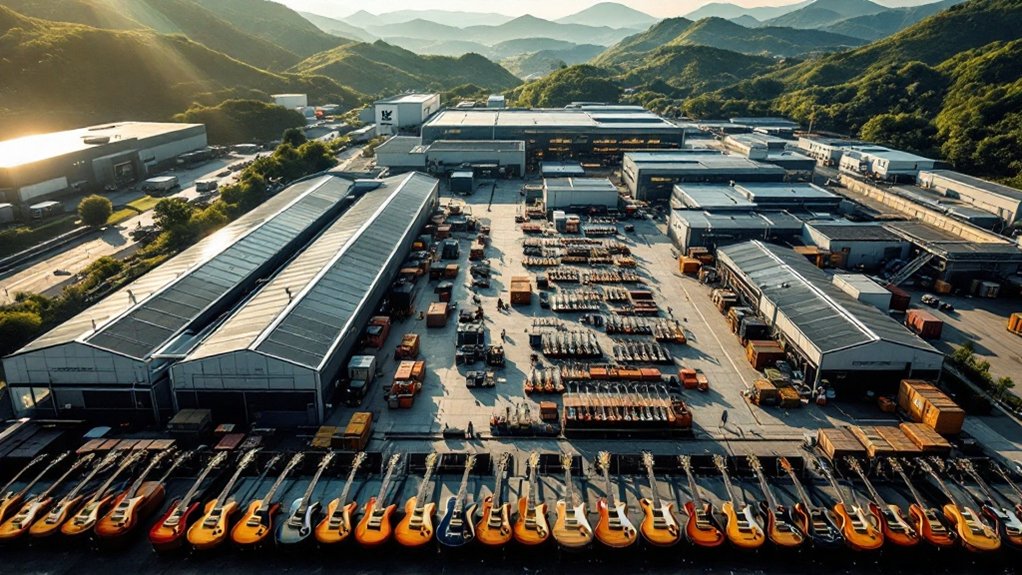
You’ll find ESP’s main manufacturing hub in Tokyo, Japan, where their prestigious Custom Shop and E-II Series facilities maintain the brand’s high-end production standards. ESP’s manufacturing network extends across Asia through strategic partnerships with specialized facilities that produce various guitar lines under strict quality control protocols. The company also operates a significant facility in California, USA, which produces select ESP-branded models, creating a global production footprint that serves different market segments and price points. This diverse production approach mirrors the construction techniques used in flat top guitars, ensuring quality across various models. Additionally, ESP guitars often fall within the price ranges of mid-range and professional grade electric guitars, making them accessible to a wide range of players. In addition, the use of quality tonewoods is essential for achieving the desired sound characteristics in their instruments.
Primary Japanese Production Hub
At the heart of ESP’s global manufacturing operations lies their primary production hub in Tokyo, Japan. You’ll find exceptional Japanese craftsmanship within multiple specialized facilities, including the prestigious Custom Shop and production centers. Each facility employs distinct production techniques to maintain ESP’s high standards. The choice of tonewood significantly influences the sound quality and resonance of the guitars produced, and selecting the right guitar string gauge can further enhance the overall musical experience.
| Facility Type | Key Characteristics |
|---|---|
| Custom Shop | Bespoke designs, individual specs |
| Craft House | Advanced tooling, specialized work |
| Guitar Work Shop | Standard series production |
| E-II Division | Premium mass production |
| Quality Control | Final inspection, testing |
The Tokyo hub maintains rigorous quality standards through specialized training at the Guitar Craft Academy, ensuring every instrument meets ESP’s exacting specifications. Additionally, the choice of wood type can influence the weight and tonal quality of the guitars produced.
Asian Manufacturing Network
Beyond ESP’s Tokyo headquarters, the company maintains a sophisticated manufacturing network spanning multiple Asian locations.
You’ll find their state-of-the-art facility in China’s Heilongjiang region, where 120-130 skilled workers, including 35 engineering technicians, drive manufacturing innovation. This facility handles Edwards production and preliminary work on select ESP models.
The company’s integrated supply chain leverages Japanese Gotoh components while maintaining strict quality standards across all production stages.
Through specialized training programs and the Guitar Craft Academy, ESP guarantees consistent craftsmanship throughout their network, empowering workers to deliver premium instruments regardless of manufacturing location. Additionally, sound quality is a key focus in their production processes, ensuring each guitar meets high-performance standards.
International Factory Distribution
ESP’s global manufacturing footprint spans strategically across multiple continents, with primary facilities in Tokyo, Japan, and Los Angeles, California.
You’ll find their renowned Custom Shop operations concentrated in Tokyo, where master craftsmen create some of the world’s finest instruments through meticulous handwork.
The Los Angeles facility focuses on premium USA-made models, extending ESP’s global distribution reach.
Through factory partnerships across Japan, ESP maintains multiple production centers, each adhering to stringent quality control standards.
This distributed manufacturing approach guarantees you get consistent, high-quality instruments regardless of where you’re located in the world.
Understanding ESP Product Lines

While many guitar manufacturers offer a single product line, ESP has developed a sophisticated multi-tier brand structure to serve diverse market segments.
You’ll find ESP product diversity spanning from the high-end Custom Shop creations to accessible LTD model variations. The E-II series has replaced the ESP Standard line, maintaining premium quality with modern finishes.
Navigator specializes in meticulous Gibson and Fender replicas, while Edwards delivers mid-to-high-range instruments comparable to ESP Standards.
Each tier features active pickups and premium materials, ensuring you’ll get professional-grade performance regardless of your chosen price point.
Quality Control Across Different Factories
ESP’s quality control systems vary strategically across their manufacturing locations, with their Japanese facilities maintaining the most rigorous standards through direct management oversight and specialized inspection protocols.
You’ll find that each factory implements specific benchmarking methods, where Japanese-made models undergo extensive hand-inspection processes while CNC-assisted production in other regions follows automated quality verification systems.
The company’s global manufacturing network maintains consistency through standardized component selection and testing procedures, though you’ll notice that their Japanese Custom Shop represents the pinnacle of their quality control measures.
Factory Standards By Region
Manufacturing standards vary greatly across ESP’s global production facilities, with each region implementing distinct quality control protocols aligned with their product segments.
In Japan, you’ll find meticulous factory practices at the Custom Shop, where artisans handcraft guitars to exact specifications. The E-II series follows similarly rigorous production techniques but with standardized processes.
California’s facilities maintain premium standards for high-end ESP-branded instruments, while Asian factories employ more automated methods for LTD models. Each facility adheres to strict material selection criteria, though production methods differ.
Japanese workshops emphasize traditional craftsmanship, whereas Asian facilities focus on efficiency and volume.
Inspection Process Differences
The rigorous inspection protocols across ESP’s global facilities showcase distinct differences in quality control methodology and execution.
You’ll find Tokyo’s Custom Shop and Original Series employ master luthiers who conduct meticulous hand inspections, checking every component against strict inspection criteria.
In contrast, overseas factories utilize more automated quality assurance systems for higher production volumes.
While E-II facilities in Japan balance craftsmanship with efficiency, maintaining detailed documentation and traceability through serial numbers, the overseas operations focus on standardized QC protocols with emphasis on cost-effective batch testing.
Quality Benchmarking Methods
While each production facility maintains its own quality control protocols, benchmarking methods across ESP’s factories follow standardized evaluation criteria to guarantee consistent excellence.
You’ll find extensive performance metrics implemented at every stage of production, from wood selection to final assembly.
ESP integrates customer satisfaction data with rigorous internal quality assessments, comparing their instruments against industry competitors. Their testing process evaluates playability, sound quality, and durability across all production lines.
Through continuous improvement initiatives, they refine manufacturing processes based on quality control data, ensuring each guitar meets or exceeds professional standards.
Market-Specific Production Strategies
As global markets demand varying guitar specifications, ESP implements distinct production strategies across its international facilities to meet regional preferences and price points.
You’ll find their production flexibility reflected in how they blend handcrafted techniques with CNC precision, adapting to market preferences while maintaining quality standards.
Their Japanese facilities focus on premium custom work and E-II models, while U.S. operations cater to high-end American specifications.
Production in Indonesia and China enables more accessible price points.
ESP’s strategic approach allows them to maintain consistent quality across all price tiers while delivering region-specific features that resonate with local players.
The Evolution of ESP Manufacturing
Since its inception in 1975, ESP’s manufacturing journey has evolved from a small Tokyo parts workshop into a global guitar production powerhouse. You’ll find major historical milestones marking their manufacturing evolution, from crafting premium replacement parts to developing innovative techniques like the shaved bolt-on neck heel.
| Period | Manufacturing Evolution |
|---|---|
| 1975-1982 | Parts & Custom Builds |
| 1983-1985 | US Market Entry |
| 1986-1990 | Production Lines |
| 1991-2000 | Global Expansion |
| 2001-Present | Multi-Facility Network |
ESP’s transformation reflects your demand for liberation from traditional manufacturing constraints, embracing custom shop precision while maintaining production efficiency. They’ve integrated premium partnerships with Seymour Duncan and mastered techniques rivaling Gibson and Fender Custom Shops.


