

The first electric guitar emerged in 1931 when George Beauchamp and Adolph Rickenbacker created the “Frying Pan,” which entered production in 1932. You’ll find that Hawaiian music’s popularity drove early development, with the Rickenbacker A-22 becoming the first mass-produced model. The real breakthrough came in the early 1950s when Leo Fender launched the Telecaster and Gibson introduced the Les Paul, innovations that would revolutionize popular music for generations to come.
Key Takeaways
- The first electric guitar, known as the “Frying Pan,” was created by George Beauchamp and Adolph Rickenbacker in 1931.
- Mass production of electric guitars began in 1932 with the Rickenbacker A-22, making it widely available to musicians.
- Leo Fender revolutionized the industry in 1951 by introducing the first mass-produced solid-body electric guitar, the Telecaster.
- The Gibson Les Paul, another influential solid-body electric guitar, debuted in 1952 following Les Paul’s earlier experiments.
- Early electric guitar development was driven by Hawaiian music’s popularity in the 1930s and the need for amplified sound.
The Birth of the Electric Guitar (1931)
Two pioneering inventors, George Beauchamp and Adolph Rickenbacker, revolutionized music history when they created the first electric guitar in 1931. Their groundbreaking instrument, dubbed the “Frying Pan” for its distinctive shape, began production in 1932 under Rickenbacker Electro. This lap steel guitar emerged during a wave of Hawaiian music popularity, setting the stage for a sonic revolution. As the electric guitar began to gain traction, its unique sound production capabilities captivated musicians and audiences alike.
More than one guitar offers tonal versatility, which became increasingly important as the electric guitar evolved. After years of research and development, Beauchamp secured his patent in 1937. Early adopters like Gage Brewer introduced this revolutionary instrument to audiences, breaking free from the volume limitations of acoustic guitars and releasing new possibilities for musical expression. The electric guitar’s design allowed for amplified sound production, enabling musicians to explore a wider range of dynamics and tonalities.
Early Design Challenges and Solutions
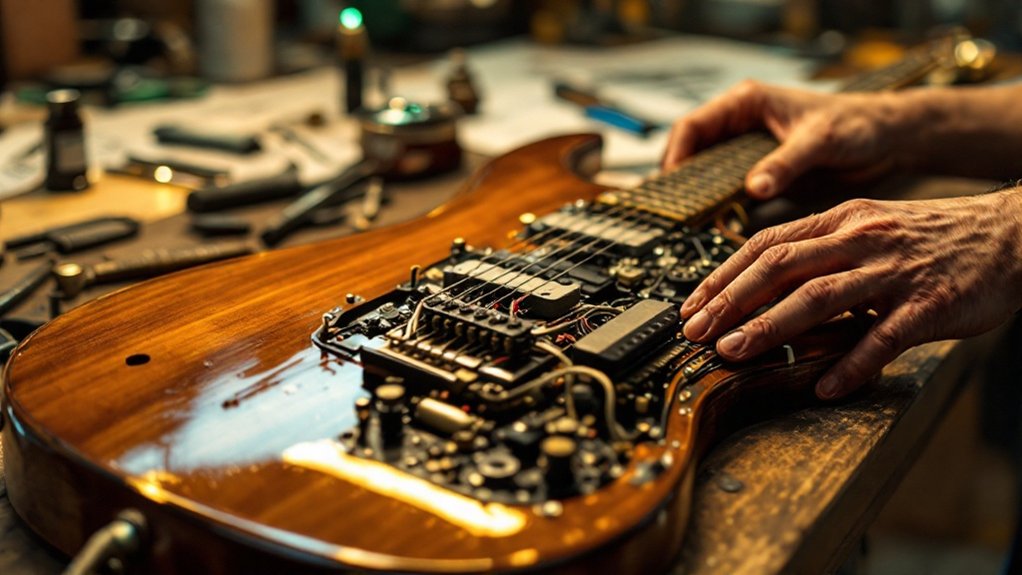
As electric guitars emerged in the early 1930s, manufacturers faced significant technical hurdles that demanded innovative solutions. You’ll find that feedback reduction drove the shift from hollow to solid bodies, while pickup innovation revolutionized sound capture. This transition mirrored the evolution of flat top guitars, which are known for their straightforward design and versatility. Material selection evolved from traditional woods to denser alternatives, improving structural stability and sustain. Electric guitars typically weigh between 6 to 10 lbs (2.7 to 4.5 kg), influencing both design and playability. Beginners often start with affordable electric guitars that help them learn the fundamentals without a significant financial commitment.
| Challenge | Solution |
|---|---|
| Feedback | Solid-body design |
| Signal Quality | Improved pickups |
| Weight Issues | Contoured bodies |
| Playability | Cutaway shapes |
Through amplification advancements and ergonomic design improvements, you’ve inherited instruments that transformed from simple electrified acoustics into precision musical tools. These innovations paved the way for the expressive freedom you enjoy today.
The Rise of Solid-Body Guitars
You’ll find Les Paul’s early experiments with solid-body guitar designs in the 1940s, including his famous “Log” prototype made from a solid pine block, laid essential groundwork for the electric guitar’s evolution. Fender’s manufacturing approach in the early 1950s revolutionized the industry by introducing assembly-line production methods and standardized parts. These innovations made solid-body electric guitars more accessible and affordable while establishing consistent quality standards that would influence guitar manufacturing for decades to come. The introduction of tube technology in amplifiers further enhanced the sound quality of electric guitars, allowing for greater tonal versatility and expression. The rise of solid-body guitars also made way for iconic models such as the Fender Telecaster and Gibson Les Paul, which remain popular choices among musicians today, showcasing the enduring influence of high gain preamps in amplifying their sound.
Early Les Paul Designs
The development of solid-body electric guitars took a revolutionary turn in 1941 when Les Paul created “The Log,” a pioneering design built from a 4×4 piece of Douglas fir with attached pickups and strings.
He encased it in hollow-body guitar halves for aesthetics while solving feedback issues that plagued traditional hollow guitars.
Though Gibson initially rejected Les Paul’s guitar innovations in 1941, they changed course after Fender’s success in 1950.
Working with factory manager John Huis, Les Paul helped develop the iconic Gibson Les Paul, featuring a mahogany body, maple top, and P-90 pickups.
This groundbreaking design would transform electric guitar manufacturing forever. The iconic Marshall tone produced by amplifiers like the Marshall DSL1CR exemplifies the sound that many guitarists strive to achieve with their solid-body guitars.
Fender’s Revolutionary Manufacturing Approach
While Les Paul pioneered solid-body guitar design with “The Log,” Leo Fender revolutionized manufacturing by introducing the first mass-produced solid-body electric guitar in 1951. His Telecaster, priced at $189.50, brought unprecedented manufacturing efficiency to guitar production.
You’ll find Fender’s innovation reflected in their precision-focused approach, which transformed the industry.
Fender’s commitment to manufacturing excellence continued with their Corona facility in 1998, where they could produce 350 guitars daily while maintaining environmental standards through the UVOX system.
This revolutionary approach to mass production made quality electric guitars more accessible and helped shape the sound of modern music.
Pioneers Who Shaped Electric Guitar History
During the early 1930s, pioneering inventors revolutionized music by developing the first commercially successful electric guitars, setting in motion decades of innovation that would transform popular music.
George Beauchamp and Adolph Rickenbacker launched this revolution with their “Frying Pan” in 1931, while Paul H. Tutmarc worked on innovative designs of his own.
Les Paul’s “Log” in 1940 introduced the solid-body concept that would later inspire influential musicians across genres.
Leo Fender transformed manufacturing with the Telecaster, making electric guitars accessible to the masses.
Gibson followed with their Les Paul model in 1952, cementing the solid-body electric guitar’s place in music history.
Hawaiian Music’s Role in Electric Guitar Development
As Hawaiian music rose to prominence in the early 1900s, its innovative steel guitar techniques sparked a revolution that would ultimately birth the modern electric guitar. The Hawaiian influence transformed American music through pioneers like Joseph Kekuku and Sol Ho’opi’i, who pushed the boundaries of guitar innovation.
| Year | Hawaiian Innovation | Impact |
|---|---|---|
| 1890s | Steel Guitar Style | Revolutionized playing technique |
| 1916 | Hawaiian Records | Outsold all other U.S. genres |
| 1920s | Resonator Guitars | Increased volume capabilities |
| 1932 | Rickenbacker A-22 | First mass-produced electric guitar |
You’ll find the steel guitar’s DNA in everything from country to rock, as Hawaiian musicians’ quest for louder, more expressive sounds led directly to electric amplification, forever changing popular music’s landscape.
Major Manufacturing Breakthroughs
As electric guitar manufacturing took hold in the 1930s, you’ll notice several companies racing to secure design patents and establish mass production capabilities.
Rickenbacker’s 1937 patent for their “Electrical Stringed Musical Instrument” marked a significant step forward, while Gibson’s entry into the market in 1935 signaled major manufacturers’ recognition of the instrument’s commercial potential.
The competition between companies like Volu-tone, AudioVox, and Dobro drove rapid innovation in design and production methods, leading to more efficient manufacturing processes and wider availability of electric guitars.
Mass Production Begins
The early 1950s marked a revolutionary shift in guitar manufacturing when Leo Fender launched the first mass-produced solid body electric guitar, the Telecaster.
Electric amplification advances and post-WWII economic growth created perfect conditions for mass production to flourish. The introduction of standardized parts, assembly lines, and quality control revolutionized how guitars were made.
You’ll find these breakthrough innovations shaped the industry:
- Consistent pickup systems for reliable sound conversion
- Solid wood body designs eliminating feedback issues
- Mechanized production methods reducing costs
- Standardized components enabling rapid assembly
This manufacturing revolution made electric guitars accessible to musicians everywhere, driving the explosion of amplified music genres from blues to rock and roll.
Design Patents Drive Innovation
Patent breakthroughs in the 1930s and 1940s sparked fierce competition among guitar manufacturers, leading to rapid design innovations that would revolutionize modern music.
The design evolution accelerated when Leo Fender patented the Stratocaster’s tremolo system in 1954, followed by McCarty’s groundbreaking adjustable bridge patent in 1955.
These patent impacts transformed manufacturing capabilities throughout the 1950s and ’60s, as Fender and Gibson dominated the market with iconic models.
You’ll see this reflected in how mass production techniques improved, making electric guitars more accessible while maintaining exceptional quality through advanced electronics and durable materials.
How Electric Guitars Changed Popular Music
Since their commercial debut in the 1930s, electric guitars revolutionized popular music by introducing powerful amplification and innovative sound possibilities that transformed how musicians performed and composed.
The electric guitar’s influence sparked a musical genre evolution across decades, pushing boundaries from Urban Blues to Rock.
You’ll recognize its impact through:
- Amplification that turned background rhythms into powerful lead instruments
- Revolutionary playing techniques that defined new musical styles
- The fusion of blues with other genres creating fresh sonic landscapes
- Enhanced stage presence allowing deeper audience connection
This versatile instrument redefined the sound of contemporary music, from jazz to folk, while becoming a powerful symbol of creative freedom and cultural change.
Landmark Models That Defined an Era
Throughout electric guitar history, landmark models emerged that would shape the future of music itself. You’ll find iconic innovations from the revolutionary 1931 Rickenbacker “Frying Pan” to the game-changing Gibson ES-150 in 1936. The guitar evolution truly accelerated in the 1950s, releasing models that would define generations.
| Year | Landmark Model |
|---|---|
| 1951 | Fender Telecaster |
| 1952 | Gibson Les Paul |
| 1954 | Fender Stratocaster |
| 1958 | Gibson ES-335 |
| 1958 | Gibson Flying V |
These designs broke boundaries, empowering artists to create new sounds and genres. From rock to jazz, each model’s unique characteristics sparked musical revolutions that continue to influence modern guitar craftsmanship.


