

If you’re looking to release your sound, you’ll want to check out the Boss SD-1 Super Overdrive for its tube-like warmth, or the BD-2 Blues Driver for that vintage vibe. The Pro Analog Overdrive offers dynamic response while the Donner Overdrive gives you two tonal modes. Don’t overlook the iconic TS9 Tube Screamer, perfect for boosting your gain. Each pedal has unique qualities, and you’ll discover even more options and tips for choosing the right one for you.
Boss SD-1 Super Overdrive Pedal

If you’re a guitarist seeking a versatile and reliable overdrive pedal, the Boss SD-1 Super Overdrive is a top choice. This legendary pedal, with its unique asymmetrical clipping circuit, delivers rich, smooth tones that mimic tube-like overdrive. Weighing just 14.4 ounces, it’s compact and built to last. The SD-1 shines across genres, enhancing everything from blues to rock with its tight crunch and light distortion. Especially, it complements both humbucker and single-coil pickups beautifully. With a price around $50 and a stellar rating of 4.7 stars, it’s a must-have for any guitarist looking to elevate their sound.
Best For: Guitarists of all skill levels seeking a versatile and reliable overdrive pedal to enhance their sound across various musical genres.
Pros:
- Durable metal construction ensures long-lasting performance.
- Produces rich, tube-like overdrive tones suitable for multiple styles, from blues to rock.
- Highly rated with a 4.7-star average, reflecting strong customer satisfaction.
Cons:
- Some users may find it lacks advanced features compared to higher-end pedals.
- May not appeal to those seeking extreme distortion rather than mild overdrive.
- Requires a 9-volt power source, which may be less convenient for some users.
Boss BD-2 Blues Driver Guitar Effects Pedal

The Boss BD-2 Blues Driver Guitar Effects Pedal is a must-have for guitarists seeking to capture authentic blues tones with modern versatility. Weighing just 10.6 ounces, this compact pedal fits easily into your gear. With level and gain controls, it delivers warm overdrive and emotive distortion reminiscent of vintage tube amps. You’ll appreciate how it responds to your playing nuances, making it perfect for both blues and hard rock. Its solid construction guarantees reliability, while the included AAA battery keeps you powered up. Praised for its sound quality, especially with Fender amps, the BD-2 offers a wide range of tonal possibilities.
Best For: Guitarists looking to achieve authentic blues tones with the versatility to play hard rock.
Pros:
- Versatile sound suitable for both blues and hard rock genres.
- High-quality sound particularly praised when used with Fender amplifiers.
- Solid construction ensures reliability and durability typical of Boss pedals.
Cons:
- Some users report minor issues with gain and volume balance.
- May require adjustments to achieve the desired tone for different amplifiers.
- Limited power source options, as it relies on a single AAA battery.
Pro Analog Overdrive Pedal for Guitar

Guitarists seeking a versatile and responsive overdrive solution will find the Pro Analog Overdrive Pedal an ideal choice. This vintage-modern dual voice stompbox features a transparent boost and dynamic clipping circuit, guaranteeing your clean signals transform into rich, singing lead tones. Its dynamic tube-like response and organic saturation engine enhance chord clarity and articulation, giving you the flexibility you need. The ergonomically spaced knobs allow for precise tone shaping, while the tour-tough aluminum construction assures durability. Compact and lightweight, it delivers consistent performance across various setups, making it a reliable companion for any gig or recording session.
Best For: Guitarists looking for a versatile overdrive pedal that delivers dynamic tube-like responses and rich tonal clarity for blues and rock performances.
Pros:
- Exceptional sound quality with natural amp breakup textures.
- Durable, lightweight aluminum construction suitable for touring.
- Compact design allows for easy integration into any pedalboard setup.
Cons:
- Requires a corded electric power source; not battery operated.
- Some users have reported concerns regarding noise reduction capabilities.
- Power supply compatibility may be an issue for certain setups.
Donner Overdrive Guitar Pedal for Electric Guitar

For those seeking a versatile overdrive option, the Donner Overdrive Guitar Pedal stands out with its two distinct modes: Warm and Hot. The Warm mode replicates the classic TS overdrive sound, while the Hot mode offers a more powerful, tightened experience. Its compact size makes it perfect for pedal boards, and with flexible tone controls for LEVEL, TONE, and GAIN, you can easily tailor your sound. Weighing only 8.4 ounces, it’s built with a durable aluminum chassis. Ideal for blues, it enhances your tone without overpowering your unique pickup characteristics, making it a reliable choice for any guitarist.
Best For: Guitarists seeking to enhance their sound without overwhelming effects, especially those who play blues and use tube amps.
Pros:
- Compact size perfect for pedal boards
- Versatile and harmonious addition to sound
- Enhances playing experience without overshadowing unique pickup characteristics
Cons:
- Some users noted it lacks gain compared to other pedals
- Power supply not included
- Limited to lower gain, making it less suitable for heavy distortion needs
JOYO Vintage Overdrive Pedal for Electric Guitar (JF-01)
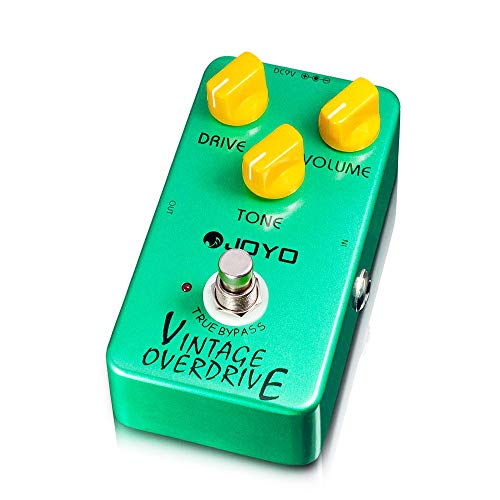
With its ability to replicate the classic TS808 tone, the JOYO Vintage Overdrive Pedal (JF-01) stands out as an excellent choice for musicians craving warm overtones and versatile sound adjustments. This pedal features an RC4558 chip, delivering a smooth shift from warm tones at low volumes to harsher distortion at higher gain settings. Its true bypass design guarantees your tone remains transparent. Weighing just 10.2 ounces and housed in a durable aluminum-alloy casing, it’s reliable for both practice and live gigs. Users appreciate its sound quality, making it a fantastic addition for rock, blues, and pop guitarists alike.
Best For: Guitarists seeking classic rock tones with versatile sound adjustments.
Pros:
- True Bypass design ensures transparent tone quality.
- Durable aluminum-alloy housing provides robust build quality for live performances.
- Excellent sound quality with versatile tonal variations suitable for multiple music genres.
Cons:
- May require an original JOYO power adapter for optimal performance.
- Limited to electric guitars and amplifiers, not suitable for other instruments.
- Some users may find the tonal range less suitable for heavier genres.
Overdrive Guitar Pedal with Two Effects

The Overdrive Guitar Pedal featuring two distinct effects is an ideal choice for players who crave versatility in their sound. You can easily toggle between flat and bright tones, allowing you to explore a range from overdrive to distortion. With three controls—Gain, Tone, and Level—you’ll find it simple to fine-tune your sound. The true bypass design guarantees your signal remains clean when the pedal’s off. Connecting the pedal is straightforward, with just one input and one output, and it operates on a DC 9V power supply. Get ready to release your creativity with this dynamic overdrive pedal!
Best For: Guitarists seeking a versatile overdrive pedal that allows easy toggling between different tones for enhanced sound creativity.
Pros:
- Versatile sound options with flat and bright tones for a range of overdrive to distortion effects.
- User-friendly controls for Gain, Tone, and Level, making sound adjustments simple and efficient.
- True bypass design ensures clean signal integrity when the pedal is not in use.
Cons:
- Power supply not included, requiring an additional purchase of a DC 9V adapter.
- Limited to two tone options, which may not satisfy all players looking for a broader range of effects.
- Single input/output connectors might restrict complex setup configurations for advanced users.
Ibanez TS9 Model Overdrive Pedal – TS9, Classic, MultiColored

Guitarists seeking a classic overdrive experience will find the Ibanez TS9 Model Overdrive Pedal to be an exceptional choice. This reissue of the original Tube Screamer boasts the same iconic components and seasick-green design. With its impressive sound quality, the TS9 enhances mid frequencies and overall tone, making it a favorite among players. It’s perfect for boosting gain without sacrificing low-end clarity, whether you’re using it with tube amps or various guitars. Weighing just 1.33 pounds, it’s easily portable, and with a 4.7-star rating, it’s a must-have for anyone looking to elevate their sound.
Best For: Guitarists looking for a classic overdrive pedal that enhances mid frequencies and overall tone without compromising low-end clarity.
Pros:
- Legendary status and tonal versatility make it a favorite among guitarists.
- Authentic sound quality that enhances the performance of various amplifiers, particularly Marshalls and Fenders.
- Lightweight and portable design, perfect for gigging musicians.
Cons:
- Limited to battery or AC adapter power options, which may not suit all users.
- Some may find the price point higher compared to other overdrive pedals on the market.
- Not as versatile for heavy distortion needs, primarily focusing on overdrive effects.
Factors to Consider When Choosing Overdrive Pedals
When choosing an overdrive pedal, you need to reflect on several key factors. Sound quality, gain and tone control, and build durability all play an essential role in your decision. Additionally, think about power source options and how well the pedal will work with your existing equipment.
Sound Quality Characteristics
Choosing an overdrive pedal involves understanding how various sound quality characteristics can shape your tone. The type of clipping circuit plays a significant role; asymmetrical clipping delivers a tube-like warmth, while symmetrical clipping produces a more pronounced distortion. Consider how the pedal interacts with your pickups—humbuckers and single-coils will yield different tonal outputs. Tonal versatility is essential, as a good overdrive can enhance your amplifier’s natural sound, offering everything from subtle warmth to crunchy aggression. Additionally, the build quality impacts response to your playing style and volume changes. Finally, true bypass switching helps maintain your original tone when the pedal isn’t in use, ensuring you get the best sound possible.
Gain and Tone Control
Understanding gain and tone control is essential for crafting your ideal overdrive sound. Gain control lets you adjust the level of overdrive applied to your signal, ranging from subtle warmth to saturated distortion. This versatility allows you to shape your sound according to your needs. Tone control, on the other hand, typically adjusts the brightness or darkness of the effect, helping you fine-tune it to match different guitars and amps. Many pedals also feature a dynamic response, where gain and tone interact with your guitar’s volume knob for nuanced performance. Remember, balancing gain and tone is vital; too much gain can create harshness, while too little may not deliver the overdrive characteristics you desire.
Build and Durability
While you might be focused on sound and tone, the build and durability of an overdrive pedal are just as crucial for your playing experience. Look for pedals with metal housings, as they offer better resilience than plastic options. A robust finish, like stoving varnish or powder coating, enhances the pedal’s ability to withstand wear and tear. Heavier pedals often indicate quality, as they contain more substantial components and sturdier casings. Ergonomically designed knobs and switches not only improve ease of use but also minimize damage from repetitive adjustments. Additionally, true bypass switching preserves your signal integrity and reduces wear on circuit components, extending your pedal’s lifespan. Investing in durability pays off in the long run.
Power Source Options
When selecting an overdrive pedal, the power source can greatly impact its performance and your playing experience. Most pedals require either a 9-volt battery or an electric supply, so you’ll want to choose wisely. Some pedals run on a single AA or AAA battery, which is perfect for portability if you’re on the go. However, many electric-powered options need a dedicated power supply, often featuring a center-negative input for compatibility with standard adapters. Keep in mind that battery-powered units can deliver a warmer sound due to lower noise levels. Finally, check if the pedal includes a power adapter or if you’ll need to buy one separately, as this affects both cost and convenience.
Compatibility With Equipment
Choosing the right overdrive pedal requires careful consideration of its compatibility with your existing gear. First, verify the pedal matches your guitar’s input impedance and your amplifier’s output impedance for ideal signal transfer. If you’re using single-coil pickups, remember that they can react differently than humbuckers, affecting your overall sound. Additionally, consider whether your amplifier is a tube or solid-state unit, as some pedals are tailored for one type over the other. You’ll also want to check the pedal’s power requirements, confirming they align with your setup. Finally, think about the signal format—whether it’s analog or digital—since this can impact compatibility with other effects and alter your tonal characteristics.
Price and Value Comparison
Understanding the compatibility of your overdrive pedal with your equipment sets the stage for evaluating its price and value. Overdrive pedals can range from around $50 to over $200, so you’ll want to reflect on what features you truly need. For instance, the Boss SD-1 Super Overdrive, priced at about $50, offers great durability and versatility, making it a solid choice. Similarly, the Donner Overdrive provides vintage sounds at an affordable rate. Keep in mind that higher-rated pedals, like the Boss BD-2 Blues Driver, tend to have better resale values, reflecting strong demand. Generally, pedals around the $50 mark receive ratings between 4.4 to 4.8 stars, showing a nice balance of quality and affordability.


