

In 2025, you’ll release your sound with the top wireless guitar systems like the Amazon Basics, known for its compact design and impressive sound quality. The Xvive A58 offers high-resolution audio, while the JOYO provides easy mobility for live gigs. Don’t forget the LEKATO’s long battery life and superior anti-interference. By choosing the right system, you can enjoy hassle-free performances without cables. Discover which option fits you best and access your full musical potential.
Amazon Basics Digital Wireless Guitar System Transmitter/Receiver
Product not found or API error.
If you’re looking for a reliable and affordable option for wireless freedom during your performances, the Amazon Basics Digital Wireless Guitar System Transmitter/Receiver is a standout choice. Weighing just 2.08 ounces, it features a compact design and a 220° rotatable plug, making it easy to connect to your electric guitar, bass, or keyboard. With a broadcast range of 100 feet and sound quality at 24bit/44.1kHz, you’ll enjoy impressive audio clarity. Users appreciate the low latency of less than 5ms, although some report occasional interference. Overall, it’s a solid option for musicians seeking convenience without sacrificing sound quality.
Best For: Musicians seeking a compact and affordable wireless system for live performances and rehearsals.
Pros:
- Compact design with a 220° rotatable plug for easy connectivity.
- Impressive sound quality at 24bit/44.1kHz with low latency under 5ms.
- Good broadcast range of 100 feet, providing freedom of movement on stage.
Cons:
- Some users report issues with interference and connection stability.
- Minor hum and disconnection may occur after inactivity.
- Documentation could be improved for better understanding of features like battery save mode.
Wireless Guitar System 2.4 GHz with Rechargeable Transmitter and Receiver

The Wireless Guitar System 2.4 GHz with Rechargeable Transmitter and Receiver stands out as an excellent choice for musicians seeking freedom from cumbersome cables. With six channels and a transmission range exceeding 20 meters, you’ll experience clear sound without interference. It’s compatible with various instruments, thanks to its 280° rotatable plug design. Charging takes just two hours for over six hours of playtime, though some users report shorter battery life. Overall, this system offers plug-and-play functionality, making it perfect for beginners or casual players. Just remember to keep a backup cable handy for those unpredictable moments.
Best For: Musicians seeking a hassle-free wireless solution for electric, bass, and acoustic guitars.
Pros:
- Plug-and-play functionality makes it easy for beginners to set up and use.
- 280° rotatable plug design enhances compatibility with a wide range of instruments.
- Clear sound quality with low latency and no interference, even in larger venues.
Cons:
- Some users report battery life can be shorter than advertised, lasting only 2-3 hours.
- Potential noise issues when using pedals or specific amplifiers.
- Constructed from lightweight materials, leading to concerns about long-term durability.
Xvive A58 Wireless Guitar System for Electric/Acoustic Guitars
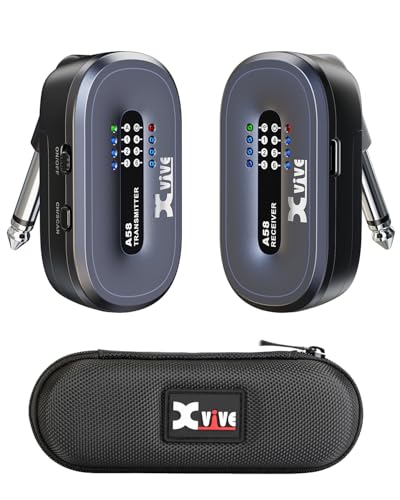
For musicians seeking a reliable and high-quality wireless solution, the Xvive A58 Wireless Guitar System stands out with its impressive 5.8 GHz true diversity technology. This system supports both active and passive pickups, making it perfect for electric and acoustic guitars. With high-resolution 24-bit/48 kHz audio and a range of up to 100 feet, you’ll enjoy crystal-clear sound without interference. The included USB-C charging port allows for quick charging—just 10 minutes gives you an hour of playtime. Weighing only 3.2 ounces, it’s easy to carry, ensuring you’re always ready to release your sound on stage.
Best For: Musicians looking for a reliable and high-quality wireless solution for electric and acoustic guitars.
Pros:
- High-resolution 24-bit/48 kHz audio for superior sound quality.
- Lightweight design at only 3.2 ounces, making it easy to transport.
- Quick charging feature allows for 1 hour of playtime with just 10 minutes of charging.
Cons:
- Some users find the design less attractive compared to previous models.
- Concerns about durability have been raised by a few customers.
- Battery life of up to 5 hours may be limiting for long performances.
JOYO Wireless Guitar System (JW-06)

Looking for a reliable and portable solution for your guitar setup? The JOYO Wireless Guitar System (JW-06) delivers with its 5.8GHz frequency, ensuring clean sound and minimal latency. It connects easily to most electric guitars and basses using 6.35mm mono jacks. With a rechargeable battery lasting up to 6 hours, it’s perfect for home practice or gigs. Weighing just 8.4 ounces, its compact design fits seamlessly into tight spaces. Users rave about its sound quality and versatility, making it a top choice for musicians. Just be cautious with the protruding units to avoid any potential damage.
Best For: Musicians seeking a portable and reliable wireless solution for their guitar setup, whether for home practice or live performances.
Pros:
- Excellent value for price; high-quality sound.
- Convenient for mobility; eliminates cable tangles.
- Easy to use with visible labeling.
Cons:
- Instructions may be unclear.
- Units protrude from instruments, increasing risk of damage.
- Occasional momentary connectivity loss may occur, potentially problematic in live settings.
JOYO Wireless Guitar System (JW-06)
Musicians seeking a reliable and portable solution for their electric guitars will find the JOYO Wireless Guitar System (JW-06) an excellent choice. Operating on a 5.8GHz frequency, it guarantees clean sound with low noise and latency. Compatible with most guitars and effects, this system features a rechargeable battery that lasts up to six hours. Its lightweight design makes it perfect for gigs or practice. Users appreciate the easy pairing and multiple signal channels, while feedback highlights sound quality and battery longevity. However, be cautious of potential connectivity loss in live settings, and note that instructions could be clearer.
Best For: Musicians looking for a reliable and portable wireless solution for electric guitars and basses.
Pros:
- Excellent value for price; high-quality sound.
- Convenient for mobility; eliminates cable tangles.
- Easy to use with visible labeling.
Cons:
- Instructions may be unclear.
- Units protrude from instruments, increasing risk of damage.
- Occasional momentary connectivity loss may occur, potentially problematic in live settings.
LEKATO Wireless Guitar System Transmitter Receiver for Electric Guitar Bass
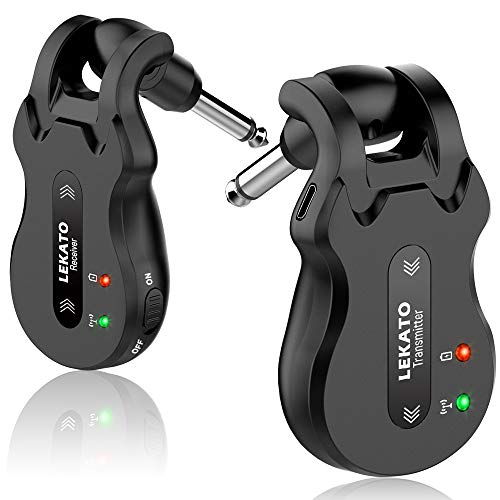
The LEKATO Wireless Guitar System stands out as an ideal choice for electric guitar and bass players seeking freedom from cumbersome cables. Operating on a 5.8GHz frequency, it delivers premium performance with a clear signal and impressive 24-bit 48kHz audio quality. You’ll enjoy a latency of less than 6ms and a range of about 100 feet. The built-in rechargeable battery offers up to 5 hours of playtime, and recharging is a breeze with the included dual USB cable. Plus, its 220° rotatable plug design guarantees compatibility with most instruments, making it a versatile addition to your setup.
Best For: Electric guitar and bass players looking for a high-quality, wireless solution to eliminate cable restrictions during performances.
Pros:
- Strong 5.8GHz frequency provides superior anti-interference and clear signal transmission.
- Built-in rechargeable battery lasts up to 5 hours, ensuring extended playtime.
- 220° rotatable plug design enhances compatibility with a variety of electric instruments.
Cons:
- Limited to a range of about 100 feet, which may not be sufficient for larger stages.
- The built-in battery requires regular charging, which could be inconvenient during long sessions.
- Some users may experience latency near the upper limit of performance in certain environments.
5.8GHz Wireless Guitar Audio System – Rechargeable Transmitter and Receiver

For guitarists seeking freedom from cables without sacrificing sound quality, the 5.8GHz Wireless Guitar Audio System stands out. With ultra-low latency under 5.5ms, you’ll enjoy minimal noise and stable audio transmission up to 50 meters. Its 282° rotatable plug guarantees compatibility with most electric and bass guitars, while the included adapter makes connecting to various devices effortless. You can count on up to 8 hours of playtime on a full charge, and a quick 2.5-hour recharge gets you back in action fast. Plus, four selectable channels let you perform alongside other musicians without interference.
Best For: Guitarists looking for a reliable and high-quality wireless solution to eliminate cables during performances and practice.
Pros:
- Ultra-low latency under 5.5ms ensures minimal sound delay for a seamless playing experience.
- Long battery life of up to 8 hours on a full charge allows for extended use during rehearsals and gigs.
- Four selectable channels enable multiple systems to operate simultaneously without interference, making it ideal for group performances.
Cons:
- Limited range of 50 meters may not be sufficient for very large venues or outdoor performances.
- Rechargeable battery requires regular charging, which may be inconvenient for some users.
- Compatibility mainly focused on electric and bass guitars, potentially limiting use with other types of instruments.
Factors to Consider When Choosing Guitar Wireless Systems
When you’re choosing a guitar wireless system, several key factors come into play. You’ll want to take into account sound quality and latency, as well as range and signal stability to guarantee a reliable connection. Don’t forget about battery life, compatibility with your instruments, and how easy the system is to use.
Sound Quality and Latency
Choosing a guitar wireless system hinges on sound quality and latency, as these factors greatly influence your performance. High-quality systems typically offer 24-bit audio at 44.1 kHz or higher, ensuring clearer sound reproduction. Latency is also essential; aim for systems with less than 5ms delay to achieve real-time feedback while playing. Be mindful of interference as well—systems using the 2.4GHz frequency may encounter more disruptions, while 5.8GHz options generally provide cleaner audio signals. Additionally, look for systems that support multiple channels to minimize interference, especially in ensemble settings. Remember, the effective range often reaches up to 100 feet, allowing you to perform freely without sacrificing sound fidelity. Prioritize these elements for an ideal wireless experience.
Range and Signal Stability
Range and signal stability are vital factors to evaluate in selecting a guitar wireless system. Different systems offer varying broadcast ranges; some can maintain a line-of-sight connection up to 100 feet, while others can exceed 164 feet under ideal conditions. Signal stability hinges on the frequency used; systems operating at 5.8GHz generally have better anti-interference capabilities than those at 2.4GHz. It’s also essential to take into account latency levels, with some systems achieving as low as 5ms, ensuring your sound remains in sync during performances. Additionally, the ability to switch between multiple channels can help you avoid interference by finding cleaner frequencies. Keep in mind that environmental factors, like Wi-Fi networks, can greatly impact signal stability.
Battery Life and Charging
Signal stability and range are important, but battery life can make or break your experience with a guitar wireless system. You’ll find that battery life varies greatly between models, with some offering up to 8 hours on a full charge, while others might only last 2-3 hours. Look for systems with rechargeable lithium batteries that charge via USB, as they’re convenient for quick recharges during breaks. Quick charging times of 2 to 2.5 hours help keep you ready for rehearsals and performances. Systems with battery indicators allow you to monitor charge levels, preventing unexpected power loss. Additionally, features like auto sleep or wake-up modes can conserve battery life when your system isn’t in use, enhancing your overall experience.
Compatibility With Instruments
When it comes to finding the right guitar wireless system, compatibility with your instrument is essential. Verify the system supports your specific type of instrument—whether it’s an electric guitar, bass, or digital instrument with pickups. Look for systems featuring a rotatable plug design to enhance compatibility with various setups. The frequency range also matters; systems operating at 2.4GHz and 5.8GHz are common, with 5.8GHz often providing better anti-interference capabilities. If you use multiple guitars or collaborate with other musicians, consider wireless systems that can accommodate multiple devices simultaneously. Finally, check that the system’s dimensions and weight suit your instrument to maintain balance and handling during performances. Your sound deserves the best connection!
Ease of Use
Choosing a guitar wireless system can be a breeze if you prioritize ease of use. Look for systems with plug-and-play functionality that simplify setup, so you won’t deal with complicated configurations. Auto pairing capabilities are also a must; they guarantee quick reconnection after your initial setup, saving you time during performances. Opt for options with rotatable plug designs, as these enhance compatibility with different instrument shapes and sizes. Additionally, systems that support multiple channels can help minimize interference, allowing simultaneous use with multiple devices. A straightforward pairing process, often just a button press, greatly boosts your experience, especially when you need to focus on your performance rather than technical issues.
Design and Portability
While selecting a guitar wireless system, you should prioritize design and portability to enhance your performance experience. Look for compact, lightweight options that weigh under 8.4 ounces; these are easier to handle and transport during gigs or rehearsals. Rotatable plugs, with angles of 220° or 280°, improve compatibility with various instruments and make using the system in tight spaces a breeze. Portable charging solutions, like built-in rechargeable batteries and compact charging boxes, add convenience and eliminate extra cables. Additionally, assess the durability of materials to guarantee long-term reliability, as some lightweight designs might compromise this aspect. Finally, choose a system that allows for easy pairing and reconnection for quick setups in mobile settings.
Interference Management Options
Effective interference management is essential for ensuring a seamless performance with your guitar wireless system. When choosing a system, consider that models operating at 2.4GHz might encounter interference from Wi-Fi and Bluetooth devices, while 5.8GHz systems generally offer better anti-interference capabilities. Look for wireless systems with multiple channels—some offer up to six—to easily switch frequencies and avoid conflicts. Automatic channel scanning features can help you find the best transmission channel, minimizing interference risks. Also, pay attention to the effective range; systems that cover up to 100 feet are ideal for live settings. Finally, prioritize low latency (under 6ms) and noise reduction technologies to enhance audio clarity and performance reliability.


