

In 2025, you’ve got some fantastic options for digital modeling pedals to enhance your sound. The Rowin Mod Station packs 11 effects, while the JOYO GEM BOX K8 offers over 160 amp models. If you’re into reverb, the JOYO Atmosphere R-14 won’t disappoint. The MOOER GE100 is sturdy and versatile, and the Zoom G1X FOUR shines with its user-friendly features. Don’t miss the Donner Arena 2000, which is packed with 278 effects. Keep reading to discover which one fits your style best!
Rowin Mod Station 11 in 1 Digital Modulation Guitar Effects Pedal

If you’re a guitarist looking for versatility without taking up too much space on your pedal board, the Rowin Mod Station 11 in 1 Digital Modulation Guitar Effects Pedal is worth considering. This compact unit features 11 unique effects, including Phaser, dual Chorus, and Tremolo, giving you diverse sounds in one place. You can customize each effect with Level, Speed, and Depth controls, making sound shaping precise and intuitive. With high-fidelity audio processing at 44.1kHz/24-bit, you won’t compromise on quality. Though some users report noise issues, many appreciate its low power consumption and functionality, making it a popular choice among musicians.
Best For: Guitarists seeking a compact, versatile effects pedal that offers a variety of modulation sounds without occupying much space on their pedal board.
Pros:
- Offers 11 unique effects, providing a wide range of sounds in one unit.
- Customizable controls for Level, Speed, and Depth allow for precise sound shaping.
- High-fidelity audio processing ensures quality sound with low power consumption.
Cons:
- Some users report issues with noise and latency.
- Power adapter is not included, requiring separate purchase.
- Smaller size may not be suitable for those who prefer larger pedals for ease of use.
JOYO Guitar Multi-Effects Processor Pedal (GEM BOX K8)
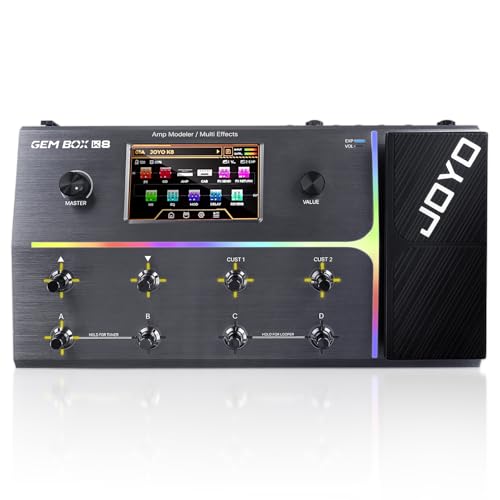
The JOYO Guitar Multi-Effects Processor Pedal (GEM BOX K8) stands out as an ideal choice for musicians seeking versatility and ease of use. With over 160 amp and effect models, you’ll enjoy 11 simultaneous effects and 400 presets at your fingertips. The 5-inch touchscreen and customizable footswitches allow for quick changes during performances. Pro connectivity options, including XLR and USB-C, make it perfect for recording or live gigs. Although some users noted issues with certain effects and MIDI functionality, its durable design and extensive capabilities make it a solid option for both beginners and seasoned players alike.
Best For: Musicians looking for a versatile multi-effects processor that combines extensive amp models with user-friendly features for both live performances and practice sessions.
Pros:
- Good build quality and durable aluminum body suitable for various environments.
- Responsive touchscreen interface and customizable footswitches for quick access to effects.
- Extensive connectivity options, including XLR, USB-C, and MIDI for versatile use.
Cons:
- User manual contains poor English and may be difficult to follow.
- Some effects, particularly wah effects, may not perform as expected.
- MIDI implementation has been reported to have issues by some users.
JOYO Reverb Pedal for Electric Guitar (Atmosphere R-14)

For guitarists seeking a versatile reverb experience, the JOYO Atmosphere R-14 stands out with its nine distinct digital reverb types, including SPRING, CHURCH, and SHIMMER. You’ll appreciate its easy-to-use MIX, DECAY, and TONE adjustments, plus modulation effects depth control. The TRAIL function guarantees your sound fades naturally, perfect for jamming in any setting. Weighing just 8.7 ounces and made from durable materials, it’s built to last. With a solid customer rating of 4.3 stars from over 2,800 reviews, the JOYO Atmosphere offers great value, making it a must-have for any guitarist’s pedalboard.
Best For: Guitarists looking for a versatile and budget-friendly reverb pedal to enhance their sound with multiple effects.
Pros:
- Offers nine distinct reverb types, catering to various musical styles.
- Easy-to-use controls for MIX, DECAY, and TONE adjustments.
- Lightweight and durable construction, making it suitable for gigging musicians.
Cons:
- Requires a specific power adapter for optimal performance.
- May not provide as many advanced features as higher-end models.
- Some users may prefer more analog-based effects over digital options.
MOOER GE100 Multi-Effects Guitar Pedal

Looking for a versatile and budget-friendly option to elevate your sound? The MOOER GE100 Multi-Effects Guitar Pedal offers 80 preset patches and 80 user patches, allowing you to create a personalized sound library. With 8 effect modules and 66 effect types, you can explore diverse tones effortlessly. Plus, it features a 180-second looper and a drum machine with various rhythms. The assignable expression pedal enhances tone control, while the LESSION button aids in scale and chord learning. Weighing just 1.61 pounds, it’s perfect for live performances or practice. Just be prepared for some manual tweaking to get the best out of it!
Best For: Musicians looking for a versatile, budget-friendly multi-effects pedal for live performances and practice.
Pros:
- Offers 80 preset and 80 user patches for extensive sound customization.
- Includes a looper and drum machine for enhanced practice and creativity.
- Sturdy design and user-friendly interface make it suitable for beginners.
Cons:
- Some users report a need for manual tweaking of preset tones.
- Firmware updates can be problematic, particularly in European markets.
- Initial programming of the expression pedal can be complex and requires patience.
MOOER GE100 Multi-Effects Guitar Pedal
Packed with 80 preset patches and a robust sound library, the MOOER GE100 Multi-Effects Guitar Pedal is an excellent choice for musicians seeking versatility without breaking the bank. You’ll enjoy 66 effect types and 8 modules, allowing you to craft diverse sounds. The built-in 180-second looper and drum machine enhance your practice sessions. Plus, the LESSION button helps you learn scales and chords effectively. While some users note the need for manual tweaking, the assignable expression pedal and adjustable output mode offer personalized tone control. With a sturdy design, this pedal’s perfect for live performances and practice alike.
Best For: Musicians seeking a versatile, budget-friendly multi-effects pedal for live performances and practice.
Pros:
- Versatile sound options with 80 preset patches and 66 effect types.
- Built-in looper and drum machine for enhanced practice sessions.
- Sturdy design suitable for both live performances and home use.
Cons:
- Some users report needing to manually tweak presets for optimal sound.
- Initial programming of the expression pedal can be complex.
- Mixed feedback on amp modeling and distortion/overdrive tones.
Zoom G1X FOUR Guitar Multi-Effects Processor

The Zoom G1X FOUR Guitar Multi-Effects Processor stands out as an excellent choice for musicians seeking versatility and high-quality sound without breaking the bank. With 71 built-in effects, 13 amp models, and 68 rhythm patterns, you can easily shape your tone. Its 30-second looper and expression pedal enhance your creativity during practice or performances. Weighing just 0.705 ounces, it’s compact and battery-powered, making it perfect for on-the-go musicians. Users rate it 4.5 out of 5 stars, highlighting its sound quality and ease of use. Whether for studio or live gigs, this pedal’s performance won’t disappoint.
Best For: Musicians looking for a budget-friendly multi-effects processor that offers versatility and high-quality sound for both studio and live performances.
Pros:
- Versatile with 71 built-in effects and 13 amp models, allowing for extensive tone shaping.
- Compact and battery-powered design makes it portable for on-the-go use.
- Highly rated by users for sound quality and ease of use, particularly for beginners.
Cons:
- Limited processor power and effects storage may require a software editor for management.
- Drum machine feature does not stop in loop mode, which can be inconvenient for some users.
- Additional expression pedal is recommended for enhanced functionality but is sold separately.
Donner Arena 2000 Guitar Multi-Effects Pedal
Product not found or API error.
With 278 effects and 100 impulse responses, the Donner Arena 2000 Guitar Multi-Effects Pedal is an ideal choice for musicians seeking versatility in their sound. It features FAVCM technology for enhanced audio quality and offers a 60-second looper and a drum machine with 40 rhythms. Its compact design makes it portable, while XLR and MIDI connectivity allows for diverse performance options. Although users appreciate its intuitive interface, some note a lack of warmth in certain styles. Overall, this pedal is perfect if you want to explore a wide range of effects without sacrificing portability or usability.
Best For: Musicians seeking a versatile multi-effects pedal that combines a wide range of sounds with portability and ease of use.
Pros:
- Intuitive interface for easy navigation and setup.
- Compact and lightweight design, ideal for travel and live performances.
- Extensive effects library with 278 options and 100 impulse responses.
Cons:
- Some users report a lack of warmth and depth in sound for certain genres.
- Notable issues with XLR output and volume drops during use.
- No dedicated bass effects or model, limiting its appeal for bass players.
Factors to Consider When Choosing Guitar Digital Modeling Pedals
When choosing a guitar digital modeling pedal, you should consider several key factors. Think about the variety and quality of effects, as well as how user-friendly the interface is for your needs. Also, pay attention to the pedal’s durability, power supply compatibility, and preset storage capacity to guarantee it fits your playing style.
Effect Variety and Quality
Exploring the effect variety and quality of guitar digital modeling pedals can greatly enhance your playing experience. When choosing a pedal, consider those with over 200 effects, including diverse amp models and unique sounds for versatility. Quality matters too; higher-end pedals often feature 24-bit/44.1 kHz resolution, ensuring superior sound fidelity while minimizing digital artifacts. Customizable effects are a must, allowing you to tweak parameters like level, speed, and depth for a more personalized tone. Also, check how many effects you can use simultaneously, as some models let you combine multiple effects for complex sound design. Finally, user reviews can shed light on the realism and effectiveness of these effects, vital for live performances.
User Interface and Controls
Choosing a guitar digital modeling pedal that offers a user-friendly interface can make all the difference in your playing experience. Look for intuitive navigation with touchscreens or dials that let you adjust effects quickly. Customizable footswitch layouts are essential for assigning specific functions, ensuring easy access during live performances. An expression pedal can elevate your performance by providing dynamic control over parameters like volume or modulation depth. Clear labeling and visual feedback, such as LEDs or displays, help you identify settings at a glance, keeping your focus on playing. Finally, an efficient layout minimizes programming complexity, allowing for quick changes and smooth shifts between sounds, whether you’re practicing or performing live.
Build Durability and Design
Build durability and design play essential roles in selecting a guitar digital modeling pedal that meets your needs. Look for pedals with rugged aluminum or metal bodies, as they can withstand the wear and tear of regular use on stage or during travel. A compact and lightweight design makes it easier to transport and fit on your pedalboard without taking up excessive space. Pay attention to the quality of footswitches; true bypass switches minimize tonal coloration and should endure frequent activation. Features like an intuitive display and well-placed controls enhance usability, allowing for quick adjustments during live performances. Finally, make sure the pedal has a solid build with high-quality connectors to prevent signal loss and maintain your sound’s integrity.
Power Supply Compatibility
When selecting a guitar digital modeling pedal, power supply compatibility is just as important as build quality. First, make sure the pedal operates on a compatible DC power supply, usually requiring 9V. Using the wrong voltage can damage the device. Next, check the current draw specifications measured in mA to match the power supply’s output, preventing insufficient power or overload. Consider whether the pedal needs a corded electric power source or allows for battery operation, which affects portability. Also, verify if a power adapter is included or needs to be purchased separately, impacting overall costs. Finally, for multi-effects pedals, look for those with USB-C connectivity, simplifying power supply requirements and enhancing compatibility with modern devices.
Preset Storage Capacity
The preset storage capacity of a guitar digital modeling pedal can considerably impact your playing experience, with some models offering hundreds of presets while others may have only a few. When choosing a pedal, think about how many presets you’ll need. A higher capacity gives you the flexibility to save and recall multiple custom sounds quickly during performances. Look for pedals with both factory and user preset slots, which let you create personalized tones alongside the manufacturer’s defaults. Additionally, some pedals offer easy preset management software or mobile apps, making organization a breeze. Finally, consider pedals that allow for seamless switching between preset groups or banks, ensuring you can change settings without lag during your live shows.
Connectivity Options Available
Choosing a guitar digital modeling pedal means considering not just the sounds you want to create but also how you’ll connect your gear. Many pedals offer a range of input and output options, like standard guitar inputs, aux inputs for external devices, and headphone outputs for silent practice. If you’re performing live, look for models with XLR outputs for a direct connection to PA systems or mixers. MIDI connectivity can enhance your setup by allowing integration with other MIDI-compatible devices. Plus, USB-C ports are great for low latency recording with digital audio workstations (DAWs). Finally, consider pedals with expression pedal inputs for additional control over parameters like volume and effects intensity during your performance.
Price and Value Assessment
While evaluating price and value in guitar digital modeling pedals, it’s essential to align your budget with the features that matter most to you. Prices can vary considerably, starting around $100 and exceeding $500 for high-end models. Assess the number of effects and amp models included; pedals with over 160 options offer greater versatility for different playing styles. Also, consider the quality of effects processing—higher fidelity (like 44.1kHz/24-bit sampling) enhances your sound experience. Look for extra features such as built-in loopers or customizable presets, which can justify a higher price. Finally, check customer ratings and reviews; higher ratings often indicate better user satisfaction and reliability, guiding you towards a worthwhile investment.
Size and Portability Factors
Portability can make or break your gigging experience, especially when it comes to guitar digital modeling pedals. The size and weight of these pedals can greatly impact how easily you can transport them to gigs or practice sessions. Compact models often weigh less than a pound and can measure as small as 3.74 x 1.77 x 1.89 inches, fitting snugly on crowded pedalboards. Look for rugged construction designed for travel, ensuring your gear withstands the demands of live performances without adding extra weight. Also, consider the pedal’s footprint, as larger options can take up valuable space. Features like built-in battery options enhance portability, allowing you to practice or perform anywhere without needing extra equipment.


